Simple guide to downsizing to a smaller space

Downsizing to a smaller space can be both a daunting yet exhilarating experience. Whether you are a young family moving from a larger home to a tiny apartment. Or perhaps a retired couple moving from a family home to a condo. Maybe like me, you just prefer a smaller home. The fact is, it’s no easy task! (That is if you have a lot of stuff to let go of).

Considering I have moved a multitude of times during my lifetime, I can tell you it is not worth taking excess possessions only to have to figure out what to do with them later. It is far better to remove them now.

You may be wondering where to start? Here are some thoughts and ideas to get the ball rolling and help you to let go of the extra stuff that’s holding you back.
  • Plan ahead: Depending on how much you have to remove, a good rule of thumb is to start three months prior to the move. This way you can work through your stuff, selling, donating and throwing away. This leaves you with some room for any hiccups along the way and a much calmer experience. It’s very stressful trying to make decisions with not enough time.
  • Start with the ‘won’t need’s’: If you know that you won’t be having a guest room or office in your new home then it makes sense to start removing those items that won’t be needed such as spare beds, linens or office furniture etc. Having a plan of your new home can help you decide what you will put in your spaces and what you won’t.
  • Essentials: It may be counter-intuitive but by assessing what is essential to your every day life, it will help you to see clearly what is not needed. Try making a list of the things you use on a daily basis then start discarding things that you don’t use.
  • Home decor: Will your current decor work in your new home? Look at pictures of your new place and imagine or plan what will go in there. Does it match the new style? Is there room for your current wall art and pictures or does something need to go? Do you even want your items in your new space or would you prefer to add something new?
  • Storage: This is a big one. How much storage space is available in your new place? If the answer is ‘not much’, then you may be motivated to let go of any non-essentials.
  • Practice tiny living: This may seem drastic but if you want to know how much you can fit into your new home then practice living that way now. Use the same amount of space in your current home and cut off the extra room. See if you stuff fits well in this smaller space. Is it comfortable to live in? This will help you realise the amount you need to declutter.
  • Live in the present: Now I will finish with this. You are embarking on a new adventure! A fresh start! Don’t clutter it by holding on to old unwanted items of the past or worry about possible needs/wants of the future. Keep what adds value to your current life by focusing on the now. Ask what you need to live a contented life. Feel the freedom of living in the present and make room for your new passions and endeavors.

Clutter can hold you back. Don’t let it 😉

For more inspiration, take a look at this post:
https://thesimplehome.blog/?p=86

How to simplify your housework

Life can be busy and stressful. Often the last thing you want to do is more housework. It may sound like a dream come true, but it is possible to simplify your house cleaning routine with a few easy changes. Just imagine, a quick clean and tidy and your house is visitor ready. Even if you have young children it is still possible to keep your house in tip top shape without burning yourself out. Lets look at how…

Firstly I want to make this clear. I love cleaning! I am actually one of those weird people who enjoys the process of cleaning. It’s like therapy for me. I feel the stress melt away while scrubbing the shower and I feel satisfied at the end result of a meticulously clean home.

There is one exception here and that is not having time to clean and yet knowing you need to. That is where cleaning can be stressful. Rushing around the house trying to get it all done is what makes cleaning an unpleasant experience. It becomes a major chore that we all want to avoid. (Even an avid cleaner like me.)

This is where simplifying your home comes in. The difference between a cluttered home and uncluttered home, is the difference between spending hours upon hours trying to keep up with housekeeping compared to a couple of short sessions a day. Yes simplifying your home will reduce your housework but where to start?

1. Turn off the tap at the source, (so to speak)

Stop the flow of stuff coming into the home to give yourself a chance to get on top of what you already have. This could mean only buying the absolute essentials for awhile. Really evaluate if you need to buy anything and don’t just accept freebies if they are not needed. Ask family or those living with you to take care of their own belongings and have set spaces for eachother’s things.

2. Start a donations box

If you haven’t got a decluttering plan you could start with a donations box. Every time you have a spare 10 minutes, do a quick declutter of a drawer or cupboard and put unwanted items in a box ready to donate. When the box is full put it in the car ready for drop-off. I have one in the laundry at all times. I pop items in there as soon as I come across something I no longer use.

5. Be ruthless with your stuff

Whatever method you choose to declutter, be ruthless! If you keep your end goal in mind of what you want your home to be, then you will be much more willing to get rid of un-needed stuff now. Don’t keep items ‘just in case’. They will only prevent you reaching your goals and make your housework complicated.

6. Keep all surfaces clear

Remove as much as possible from all surfaces. Only keep what you really need or want on them. This makes cleaning much more efficient.

7. Declutter nic-nacs

Having too many small items makes dusting and cleaning hard. Only keep the bare minimum on display.

8. Consider removing your shoes before entering

Not a simplifying tip as such but not wearing shoes indoors means a lot less dirt is tracked in and so floors stay alot cleaner.

9. Make your bed in the morning

Make your bed as soon as you get up and keep bedding to a minimum. Remove excess pillows, throws and blankets to simplify the process. It will set the mood for the day.

10. Re-wear clothing

It’s okay to repeat outfits that are still clean and don’t smell. Teach your children to do the same. Often we create more washing unnecessarily.

11. Keep a small wardrobe

Keep simplified wardrobes so that putting away clothing is quick and easy.

12. Fold clothing immediately

If you fold clothing immediately after hanging it to dry then you will have less ironing to do.

13. Remove excess furniture

Remove unnecessary furniture from the home. Less furniture means less to dust. Your home will also appear bigger.

14. Don’t keep any clutter in the bathrooms or toilet

Keep the essentials only. Makes cleaning in these highly used areas easier.

15. A team effort

This may be one of the most important tips for a tidier home and that is that everyone is responsible for their own stuff. It has become a habit in our home that once you are finished with something you put it away.

Simplifying and making these small changes has made a huge difference to my housekeeping routine. I hope it will make a difference to yours:)

For more housekeeping ideas check out this post on Housekeeping the old fashioned way

https://thesimplehome.blog/?p=54
https://www.pinterest.com.au/pin/732468326896244165/

About me

Hello, I’m Megan! A Wife, Mother, Christian & home-maker. One of my passions is living simply, with as few possessions as possible and in a sustainable way.

My journey to minimalism began when I was 16 years old and moved to Australia with my Mother. I was asked what i wanted to bring and there was really nothing other than a suitcase of basic clothing, some toiletries and a stuffed toy my brother’s had given me. I just wasn’t attached to material goods. However over the years I did begin to accumulate things, especially after getting married and getting ready to have our first baby. This is when I became an ‘intentional’ minimalist.

Becoming an intentional minimalist was around 2011 right before our first child was born. It was a busy time. We had been married over a year, were selling and moving to a new home as well as preparing for our first baby. I remember as I was packing during those weeks before moving feeling really overwhelmed by stuff. Not that we were hoarders or owned any more than the average home. In fact we probably owned less than most just because we were newly weds.

However there was still too much unnecessary stuff that had accumulated together as well as what we each owned prior. Unused wedding gifts, ALOT of health & study books on my part, un-necessary furniture, kitchen items, paperwork, excess clothing and just stuff! Oh and not forgetting the room full of baby gifts from my recent baby shower!

Packing & decluttering

Anyone who has had to pack and move knows that when you are handling each and every item you own, you soon realise that there is much more than you expected. I began to question why we owned what we owned. At the same time I had ordered a book on decluttering from a catalogue. (I know that is such an outdated way to buy books!) I also started doing google searches on decluttering. At the time I was not aware of the term minimalism or living simply but when I came across the idea of living with less. It really resonated with me. I do believe I’ve always been a minimalist at heart. Just because I now had my own home, did not mean I had to accumulate excess stuff.

A defining moment

A defining moment for me was when my sister in-law came to help us move and gave me a small plastic disposable vase with hand-picked flowers. Something about it made me wish that I could have packed a lot lighter. I had already begun shedding some items before moving but now I had moved into our freshly renovated new home, I decided I was going to live as simply as I could. I do believe that having a baby also gave me a desire to keep things as simple as possible.

The journey continues…

Over the next 10+ years I have grown in many ways and also came to understand how living with less impacted my Faith. Or rather how my Faith defined living simply. The bible has a lot to say about not storing up treasures and going after riches as well as giving to others in need. These scriptures help shape my journey of simplicity.

On a daily basis, living simply helps keep my home calm and orderly as well as my mind. I want to be able to focus on what matters. Of course I am not perfect and sometimes stuff just seems to grow!

Sharing my journey and pictures of my home also helps keep me accountable. My hope is that this blog and my experience with living simply can also inspire you to live simply also

Whether you are a beginner minimalist or further along in your journey, I hope that you will find some inspiration here.

Feel free to contact me with questions, comments or introduce yourself 🙂

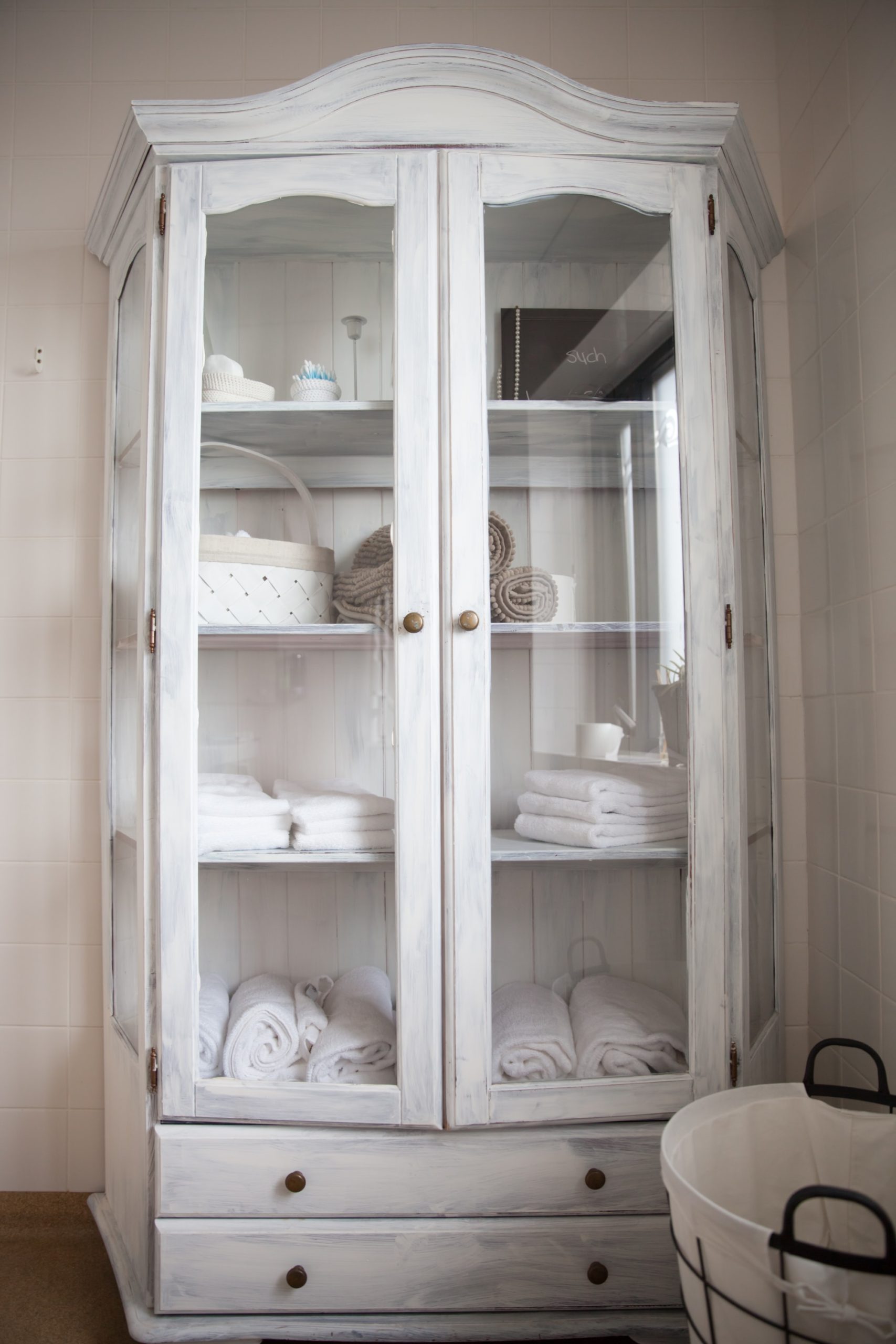
Simple Linen Closet

It’s the beginning of Autumn here in Australia and I decided to do a linen closet declutter and organise. I usually go through clothing as the Seasons change but this time I decided to go through bedding and blankets to see what we may need and get rid of the rest.

To be honest this space has been bugging me for quite awhile and I have avoided it as I tend to find it hard to decide which linens to keep as they are all in good condition and I keep extra bedding and blankets as a ‘just in case’. Alot of throw blankets and quilt covers! This time I was ruthless!

Kon mari method

I decluttered the closet Kon mari style. I took everything out and only put back in what I really loved. Usually I would rummage around trying to decide what to get rid of, which obviously wasn’t working. Before I began, I had saved some gorgeous Pinterest pics for inspiration. I wanted my linen closet to be VERY minimal, functional and lovely to look at.

I wanted my linen closet to be VERY minimal, functional and lovely to look at.

A tip I had found was to place my linens front ways rather than across. (If that makes sense?) You can see how I have placed them in the pics below. My goal was to keep what we have on our beds with only a couple of extras stored. We really don’t use what has been sitting n there and I found that things weren’t smelling very fresh, which is a sure way to know that you are using things regularly. I washed everything, ready to sell, donate or keep. I even soaked some towels to bring them back to pure white. Yes I went all out!

The Essentials

There was also a lot of ‘extras’ such as seasonal decor, toiletries, fabric, cushions, even a photo album! It was really an added storage space which I was just tried of. I decided that this was going to be purely for linens only.

Note: Each be in the house has sheets, a quilt and blanket. Towels which are in use plus what’s stored here. There is a throw blanket on the sofa. I will continue to evaluate what’s no longer needed at the end of the season.

The Kon mari method was really helpful to me in this case as I really didn’t want to put any clutter and excess back in, once I had completely cleared out and cleaned the cupboard. I believe every space should be beautiful.

I feel relieved after finally simplifying my linen closet and getting rid of the excess. The final finishing touch is to add some pretty labels to the shelving. Let me know how you declutter and organise your linen closet:)

Minimalist Wardrobe-signature colour

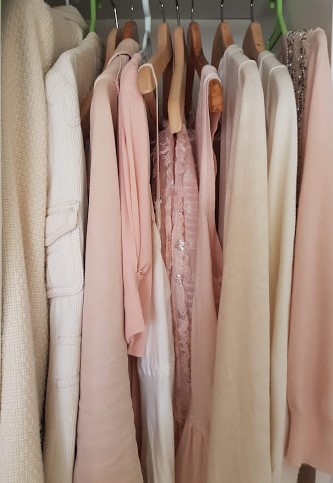
There are a lot of ways to reduce your clothing to create a simpler wardrobe. One of the easiest ways to dress is to have a signature colour. I hadn’t heard of the term until a few years ago when listening to a French podcast and how French women tend to have their own personalised signature colour. I realised that I had been naturally doing this anyway. I love pink! Anyone who knows me, know that it is my favourite signature colour. It has always been my colour yet it has evolved over the years from barbie pink to baby pink to a now light dusty pink. Of course it isn’t the only colour I wear, however it is my core colour in which I add and blend other flattering colours such as creams and soft neutrals.

Many minimalists work with black or navy to mix and match easily. Personally dark colours are very draining and unflattering for and so I avoid them. I used to also feel like I should wear other colours because that is what is expected. I tried adding what was on trend or what I sort of liked, but now I have embraced the idea of wearing what I always feel good in. Pink.

It keeps your wardrobe simple

The benefits of focusing on a signature colour are many, such as ease of shopping when you know exactly what you are looking for. Washing is simplified as you can do a large wash with similar colours. Your wardrobe naturally works together better when you work with one colour. And as mentioned, you feel good in the colour you are wearing, no more trying to look right in colours you are unsure of.

You may be thinking that this is not for you especially if you like a variety of colours. Which is totally fine. Wear what works for you! Most people gravitate toward the same colour or colours anyway.

Your unique colour

This is not the same as having base colours for a capsule wardrobe. These are usually neutrals that work well together. Your signature colour is the colour that says YOU! It is the colour that suits your personality and makes you feel great. You don’t have to have an entire wardrobe of the colour but you may choose to have pops of this colour to add to your neutrals. It is still your unique colour.

So as I embraced my favourite shade of pink complimented with creams and whites, I then decided to weed out the colours of clothing I didn’t enjoy. This created a wardrobe that nearly always works for me. I say nearly because there will still be shapes and styles of clothing I no longer like as well as clothing which is worn. The best part of having a signature colour is that my wardrobe is far more simplified. I love it!