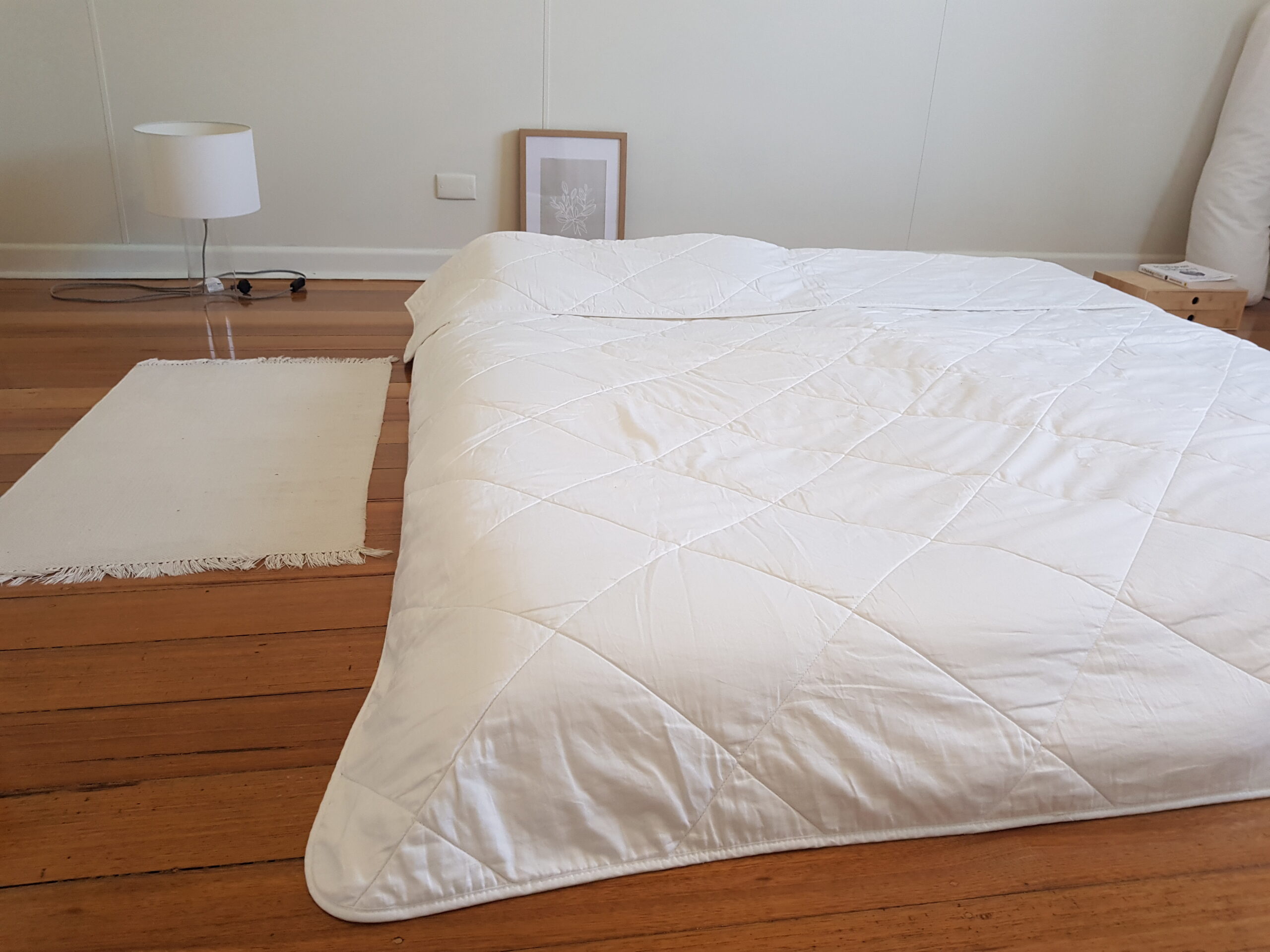
Something that I don’t reveal to many people is the fact that my husband and I sleep on Japanese futon’s. Technically called Shikibuton or traditional Japanese futon’s, they are becoming quite popular within the extreme minimalist community.
Why choose to sleep on Japanese futon’s or floor sleeping?
There are different reasons for choosing to sleep on futons or other styles of floor sleeping but I will share some of the benefits and reasons for us and also some of the down-sides of sleeping on the floor. Firstly I have found that my back and pelvic alignment has improved with sleeping on a firmer surface. This may be achieved on a traditional firm mattress but we have found that you can customise a Japanese futon quite easily by adding a pad underneath or topper if it doesn’t feel soft enough. We have wood flooring so having a thin foam topper underneath gives just the right cushioning for the firm cotton futon.
Free’s up space
The Japanese futon is great for minimalists or those who want to maximise space. In our current home this is not a necessity but I know it would have been helpful to have these in previous homes we have lived in where space was at a premium. Being able to fold or roll them up during the day means you can use the floor space in a room for dual purposes. At the moment I use that space for exercise.
Easy to move
When we moved interstate 3 years ago we didn’t bring our old bulky mattress but sold it and brought along our single futon mattresses that we had acquired a few months before. This was obviously much easier than moving a traditional mattress and bed base as well as the space saving as we had to fit all of our belongings in a small trailer. Our oldest daughter had an air mattresses as a temporary bed and we had a toddler sized futon for our toddler. It was super easy to set up our bedrooms.
Eco-friendly option
Depending on the type of futon you buy, it can be a good eco-friendly option if you choose a cotton fill or another natural material. A lot of traditional mattresses have springs, fire-retardants or other toxic chemicals added to the foam core or materials used to construct the mattress. Eco mattresses can be quite expensive so a futon or something similar is a nice healthy alternative.
More hygienic
Some may argue that sleeping on the floor or putting a mattress on the floor is un-hygienic. However I have found it to be far more hygienic since there is no dust accumulating underneath and the Japanese futons are light enough to take outside to air on a regular basis so that the sun can sanitise the mattress and prevent dust mites. The futons smell fresh and I wash the covers each week along with the fitted sheet. The floor underneath gets wiped cleaned. Our room is now quite dust-free and easy to clean. On the contrast a traditional mattress accumulates dust, damp and other nasties even if you use a mattress protector.
Closer to the ground
A positive to sleeping close to the floor is that you need to get up from the floor! This has helped us to be more flexible and build strength as it takes more effort getting up and down. This could be a pro or con depending on your health and ability. I doubt I could have done this during pregnancy for example but I know others who were fine with it. Also some have found that the floor sleeping experience has felt grounding (literally). They find it a more comfortable experience sleeping closer to the ground especially those who sleep directly on the floor with maybe just a thin pad or sheet underneath. (I’m not there yet!).
Kid friendly
Most families who try this say that their children naturally love floor sleeping. I have noticed that too. Another benefit is that you don’t need to worry about younger children falling off of the bed so it’s a great way for children to transition to sleeping alone. They seem to find floor sleeping fun and kind of like camping! I was first introduced to floor sleeping a decade ago because of the Montessori approach I was using for our first child. It made a lot of sense and so we gave it a try.
Aesthetically pleasing
Okay well this is a case of personal preference! Many extreme minimalists like myself find it to be a beautifully calm and visually appealing aesthetic. Something about not have a bulky frame or headboard dominating the room makes for a pleasant and minimal bedroom appearance. Of course it’s not for everyone and that’s fine but if you like that minimal look then floor sleeping could be for you!
Now for the cons…
There are not too many negatives to floor sleeping in my opinion but I will still share my experience as something to think about when deciding if floor sleeping is for you or not.
Our beds are not always ready to jump into!
During the day I fold our futons up and move them to the wall and take our the toppers from underneath. I fold our quilt and move it aside too. This means more work in the morning and also more work at night to prepare for bed. I’ve gotten more efficient at this but it can sometimes be annoying to have to do. If we didn’t have toppers underneath I think it would be easier.
Our room can look messy
This may surprise you but our room can look messy due to the bedding sitting on the side of the room and our toppers against a chair. The futons themselves are totally fine folded or left laying flat but otherwise you may want to have a cupboard to store away the bedding and pillows at least to give the room a neater appearance. The Japanese have special cupboards to store the futons and bedding so this would make more sense and look a lot better. I still love the look of the futons though!
Potential for mold
As mentioned above, futon’s are very hygienic but only if you look after them. Depending on your climate, there is a potential for mold if left on the floor. Obviously this is not hygienic nor healthy! So airing regularly is a must. I get them out in the sun twice a week or fold them up most days so that they are off the floor. We have single futons so they are light.
There is a transition period
Depending on what type of bed you are used to, there will be a transition period. For us it didn’t take too long as we had been sleeping on a western futon prior to the Japanese futon. Our previous futon was on a base and then we switched over the the Japanese futons which need to go on a flat surface. It took about a week for us but then we also had a thin topper underneath as the wood floor meant no cushioning and this combination worked well for us. Others say it took up to a month but then felt really good. It’s good to be prepared for a little discomfort in the beginning.
People may think your weird
Floor sleeping is not something I often share with others unless it’s with my minimalist community. Some friends or family that know about it, think it kind of strange and un-neccesary. As always I don’t let that deter me as it works for us. Extreme minimalism isn’t for everyone and I’m okay with that:)
There may be other negatives but these are the only ones I have had. Overall they are a wonderful minimalist sleeping option and even better if you are able to floor sleep without any mattress at all. Now when I go away and sleep on a ‘normal’ bed I find them pretty uncomfortable upon waking as my back doesn’t like the softness. I look forward to my cosy floor bed which feels like a cocoon:)
Hopefully this post has given you a little food for thought when it comes to floor or futon sleeping. Sweet dreams!